
Powering Your Well Pump During Outages: Backup Generators & Solar Options
When the utility power goes out in a suburban subdivision, residents lose their lights and television. When the power goes out on a rural Central Valley property, you lose your water.
Because private well systems rely entirely on electrical pumps to draw water from the aquifer, a power outage instantly cuts off your household water, toilets, livestock waterers, and crop irrigation.
Securing a reliable emergency power strategy—whether through a backup generator or a solar-powered array—is vital for rural homestead security. This guide covers your options.
Understanding Submersible Pump Power Demands
Before buying backup power equipment, you must understand how well pumps consume electricity.
- Running Watts vs. Starting Watts: A motor consumes a steady flow of electricity while running (running watts). However, when the motor first starts up, it must spin a heavy pump shaft and lift a massive column of water hundreds of feet up. This requires a brief, massive surge of power (starting or surge watts) lasting less than a second.
- Starting Surge Multiplier: A typical submersible pump requires 3 to 4 times its running wattage to start. If your generator is sized only for the running watts, its circuit breaker will trip instantly the moment your pump attempts to kick on.
| Pump Horsepower (HP) | Average Running Watts | Required Starting (Surge) Watts | Recommended Generator Size |
|---|---|---|---|
| 1/2 HP | 1,000 W | 3,000 W | 4,000+ W |
| 3/4 HP | 1,200 W | 3,600 W | 5,000+ W |
| 1 HP | 1,500 W | 4,500 W | 6,500+ W |
| 1.5 HP | 2,000 W | 6,000 W | 8,000+ W |
Option 1: Portable and Standby Generators
Generators are the most common and cost-effective backup option for rural homeowners.
Portable Generators
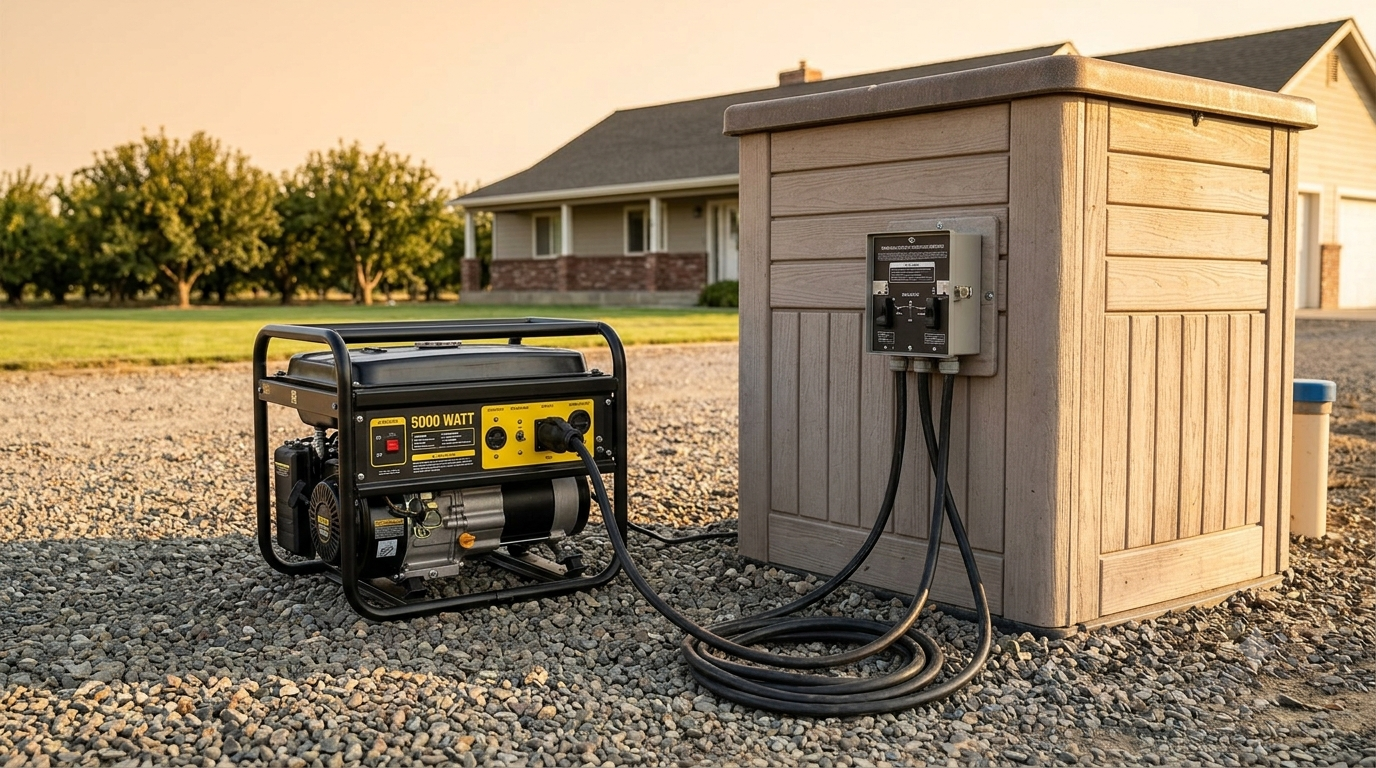
A standard portable gasoline, propane, or diesel generator is highly effective if sized correctly.
- The Connection: You cannot simply plug a generator into a standard wall outlet. You must have a licensed electrician install a Manual Transfer Switch and a dedicated generator inlet box near your main breaker panel.
- Clean Power: Ensure your generator has low Total Harmonic Distortion (THD) to protect sensitive pump control electronics and Variable Frequency Drives.
Whole-House Standby Generators
A permanent standby generator (such as a Generac or Kohler running on liquid propane or natural gas) sits outside your home and activates automatically within seconds of a utility outage. It handles the startup load of your well pump seamlessly, ensuring your household never loses water pressure.
Option 2: Solar-Powered Well Systems
For a highly sustainable, silent, and maintenance-free backup solution, solar power is an excellent choice for Sunny Central Valley homesteaders.
Direct DC Solar Pumps
These systems bypass the utility grid entirely.
- How They Work: Solar panels connect directly to a specialized DC submersible pump. As long as the sun is shining, the pump runs, filling a large gravity-fed water storage tank (e.g., 2,500 gallons) on your property.
- No Batteries Required: By storing water instead of electricity, you eliminate the massive cost and maintenance of large battery banks. Water is delivered to your home via gravity flow. Read about off-grid designs in Off-Grid Well Water Systems for Homesteaders.
Solar Battery Inverter Systems
If you want to run a standard 230V AC well pump on solar, you must install a high-capacity solar panel array connected to a premium battery storage bank (such as Tesla Powerwalls or lithium-iron-phosphate batteries) and a heavy-duty inverter capable of handling the pump’s massive startup surge.
Emergency Well Power Safety Guidelines
- Never Backfeed: Never run a “suicide cord” from a generator into a household outlet. This can backfeed high-voltage electricity onto utility lines, potentially injuring utility linemen working to restore regional power.
- NEMA Heat Management: Keep portable generators shaded and ventilated. Central Valley summer heat can overheat generator engines rapidly under the high-load of a deep-well pump start. Read more in Why Well Pumps Fail in the Summer.
Design Your Emergency Power Strategy
At Ingram Pump & Equipment, we help Central Valley landowners plan for ultimate water security. We coordinate with local electricians to set up safe generator transfer connections and install highly efficient solar-ready pumping systems.
- Check Our Off-Grid and Home Well Services
- Request an Emergency Backup System Consultation
- Call the Ingram Team today at (559) 734-3362 to protect your water supply
Frequently Asked Questions
Can a standard generator run a deep submersible well pump?
Yes, but you must size the generator correctly. A well pump requires a massive 'starting surge' wattage (often 3 to 4 times the running wattage) to kick-start the submerged motor against water column weight.
How big of a generator do I need for a 1 HP well pump?
A standard 1 HP well pump typically requires about 1,500 running watts, but needs up to 4,000 starting watts to kick-start. We recommend a generator with at least 5,000 'starting' or 'surge' watts to safely handle a 1 HP pump.
What is a manual transfer switch and do I need one?
Yes. A manual transfer switch is legally required by electrical codes. It safely disconnects your home and well system from the utility grid before connecting to a generator, preventing dangerous electrical backfeeding onto utility lines.
Related Articles
Off-Grid Well Water Systems: A Guide for Central Valley Homesteaders
Planning an off-grid homestead? Here is what you need to know about setting up a reliable well water system that actually works in Tulare and Kings County.
DIY Well Pressure Tank Care: Checking Air Charge and Precharge Pressure
A step-by-step DIY guide on checking, testing, and recharging your water well pressure tank air precharge pressure to extend your pump lifespan.
Hard Water Treatment for Private Wells: Calcium Scale Prevention
Struggling with calcium scale from private well water? Learn how hard water damages your pump and plumbing, and find out the best water softener and filtration solutions.